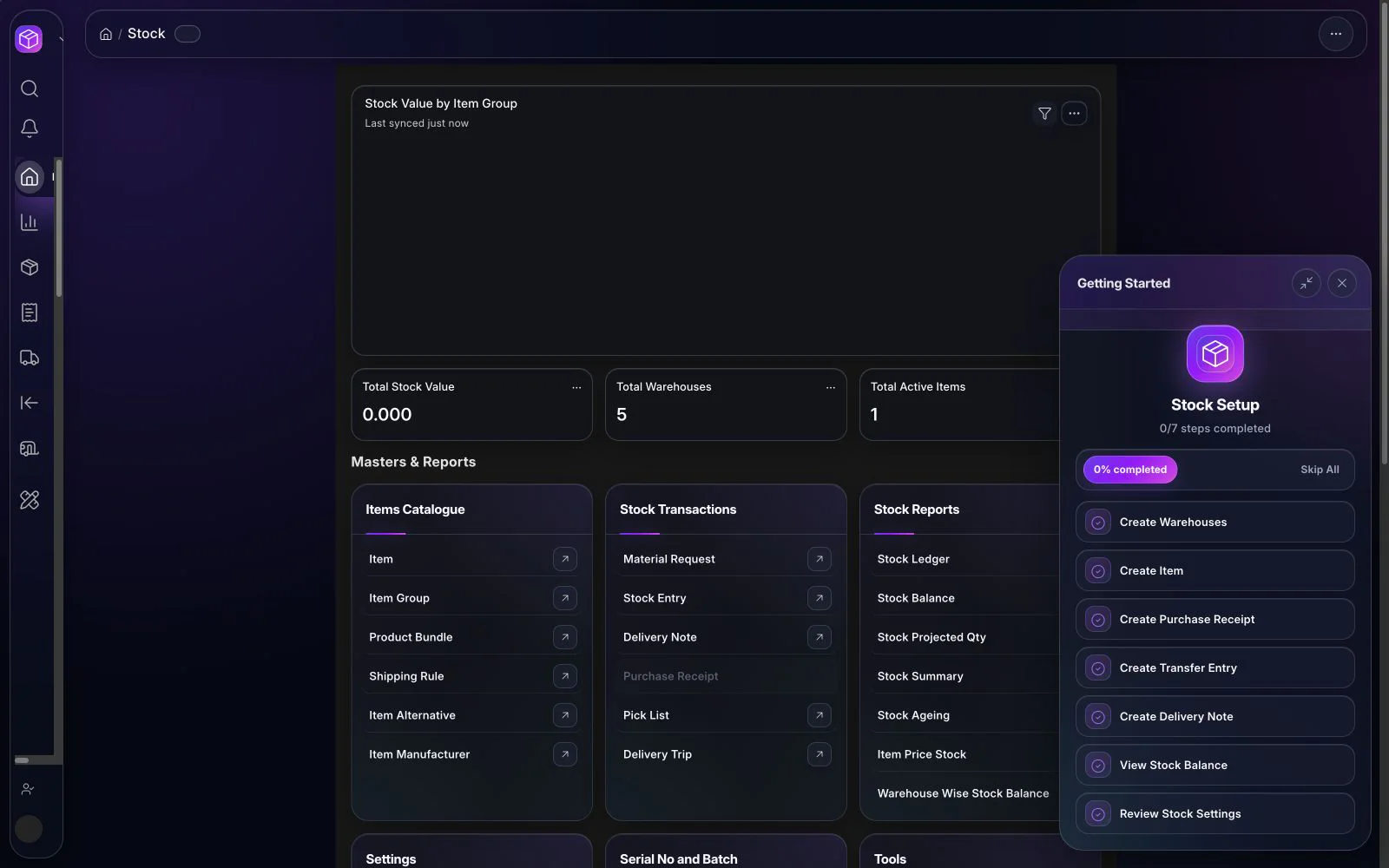
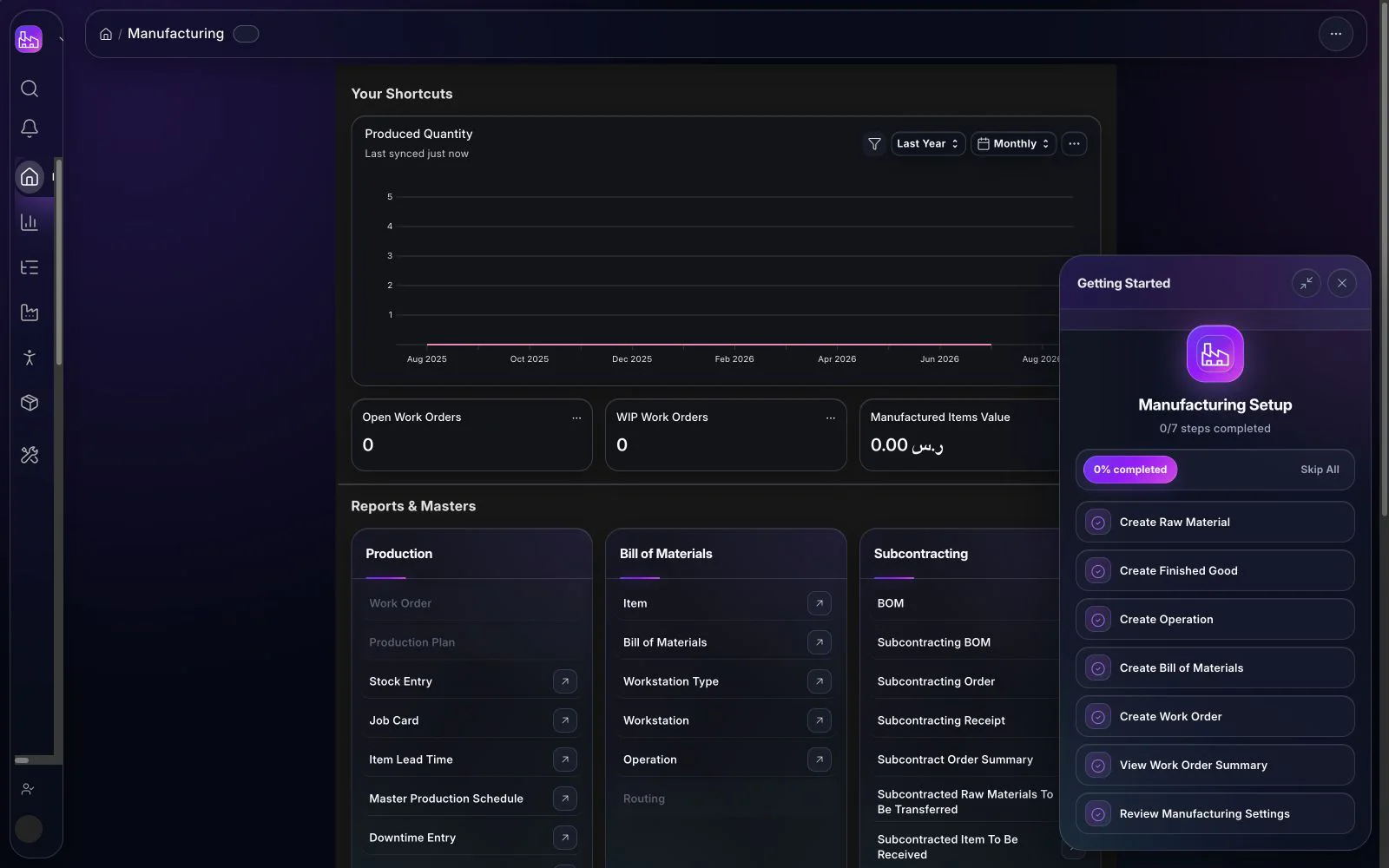
A bill of materials defines what a product should consume, a work order authorizes and tracks what production should make, and manufacturing costing compares the expected material and operation inputs with the transactions actually recorded. These records become useful only when item masters, BOM versions, routings, workstations, warehouses, time capture, stock movements, and accounting policy are governed together.
How BOMs, work orders, and cost records fit together
The BOM is the controlled product structure: finished item, quantity, raw materials, subassemblies, operations, scrap assumptions, and expected inputs. A production plan translates approved demand into quantities and material requirements. A work order selects the BOM and quantity to produce, schedules operations, and provides the reference for material transfer, consumption, job cards, completion, and finished-goods receipt.
Costing then follows those records. Expected cost may use BOM quantities, component valuation or approved rates, operation time, and workstation rates. Actual production context comes from issued and consumed material, completed quantities, time logs, scrap, rework, and the stock and accounting entries created by the agreed workflow. A variance is a signal to investigate; it is not automatically evidence of waste or an accounting error.
1. Govern the BOM as a production standard
Give every manufactured item an accountable BOM owner and an approval rule. Define the output quantity, stock units, component quantities, source warehouses, scrap or process-loss assumptions, operations, sequence, time standards, and applicable workstation. Where a product uses subassemblies, decide whether they are stocked, produced against their own work orders, or transferred directly through the production flow.
Do not overwrite a production standard without understanding open orders. Use a controlled effective-date and version approach, document the reason for every material or routing change, and test how revised BOMs affect planned requirements and cost estimates. BITEX provides BOM update, comparison, explorer, stock, and variance tools inside the Manufacturing workspace.
2. Separate the product structure from the process route
A component list answers what is required; operations and routings answer how work should pass through the plant. Define operations such as cutting, assembly, inspection, or packing, then associate them with suitable workstations, expected setup or run time, operating components, calendars, and rates. Keep units and time bases consistent so a ten-minute operation is not interpreted as ten hours.
Capacity planning depends on these standards and the working calendar. It should identify load and scheduling conflicts for review, not promise that production will occur exactly as scheduled. Breakdowns, absenteeism, material shortages, priority changes, and quality holds still require a controlled rescheduling process.
3. Turn approved demand into a production plan
Start with agreed demand sources and planning horizons. A production plan can consolidate required finished quantities and explode BOMs into subassembly and raw-material needs. Review available and projected stock, open supply, safety policies, lead times, batch constraints, and warehouse responsibility before approving work orders or material requests.
Planning quality depends on current orders and dates. Old sales orders, incomplete BOMs, unreliable lead times, duplicate items, or late stock transactions create false shortages and false availability. Assign owners to review planning exceptions and close or correct stale documents before releasing work.
4. Use the work order as the execution contract
A work order should state what to make, how much, which BOM and operations apply, where materials come from, where finished goods will be received, and the planned dates. Release it only after checking material and capacity constraints appropriate to the business. Define who can change quantity, dates, warehouses, or status after release and how those changes are communicated to the shop floor.
Test partial production, excess or short completion rules, alternative materials where authorized, material return, additional consumption, scrap, cancellation, and rework. The aim is traceability from the work order to each stock movement and operation record, not merely a final “completed” status.
5. Capture operation work with job cards
A job card links an operation to a work order and can record the workstation, assigned work, timestamps, completed quantity, and operation progress. Decide whether operators record work at a shared terminal, workstation device, scanner, or supervisor station. The interface and permissions should make timely entry easier than end-of-shift reconstruction.
Define procedures for pause, restart, breakdown, rejected output, rework, shift handover, and correction. Time records are useful for capacity and cost analysis only when users understand what starts and stops the clock and supervisors review unusual duration or quantity promptly.
6. Control material movements and finished-goods receipt
Manufacturing must connect to Inventory & Stock. Establish the approved pattern for material transfer, material consumption, work-in-process, scrap, rejected goods, and finished-goods receipt. Define source and target warehouses, whether consumption is backflushed or explicitly recorded, and when batch or serial information must be captured.
Reconcile issued, returned, and consumed quantities to the work order. A convenient stock adjustment outside the production flow can hide the source of a variance. When physical practice differs from the system record, investigate timing, units, substitution, yield, scrap, and incomplete transactions before posting a correction.
7. Build quality into the production workflow
Use the Quality Management workspace to define where inspection is required, which parameters and readings matter, who records them, and what happens when a result fails. Quality controls may apply to incoming materials, in-process work, or completed goods. The hold, release, rejection, rework, and concession decisions need named authority.
Connect quality exceptions to the affected item, batch, work order, operation, supplier, or workstation where possible. A cost-of-poor-quality or inspection summary becomes actionable when the team can trace the reason and corrective action rather than only count failed records.
8. Connect purchasing and subcontracting
Material shortages may create approved demand for Purchasing & Procurement. Define how buyers see required dates, specifications, quality conditions, alternate suppliers, and the production consequences of delay. Do not convert every planning suggestion into a purchase order without review of on-hand stock, open supply, minimum order quantities, and changing demand.
For outside processing, use the Subcontracting workspace to connect the subcontracting BOM, order, supplied raw materials, receipt, and status reports. Clarify ownership of material at the supplier, expected loss, quality acceptance, additional service cost, and reconciliation of material sent versus finished or returned.
9. Understand the layers of manufacturing cost
A useful manufacturing-cost model separates direct material, direct operation or labor inputs, machine or workstation rates, eligible production overhead, subcontracting, scrap, rework, and other treatments required by the company’s approved policy. The BOM can estimate standard inputs, while work-order and stock records show what was actually recorded. Finance must define which amounts become inventory cost and which are period expenses.
International Accounting Standard 2 explains that inventory cost includes costs of purchase, costs of conversion, and other costs incurred in bringing inventory to its present location and condition, subject to the standard’s rules. Review the IFRS Foundation IAS 2 overview with qualified advisers. BITEX configuration implements an approved policy; it does not choose the applicable accounting treatment for the company.
10. Investigate cost variance instead of hiding it
Compare expected and recorded quantities, component rates, operation time, workstation rates, yield, scrap, and completed output. A favorable or unfavorable cost variance can result from price movement, approved substitution, inaccurate standards, unit conversion, late entries, excess issue, unrecorded return, downtime, rework, or a different production quantity.
Set materiality and responsibility rules. Operations should investigate physical usage and time; engineering should review BOM and routing standards; procurement should explain purchase-rate changes; quality should identify defects and rework; and finance should reconcile valuation and posting. Update standards only through approval—never merely to make a variance disappear.
A representative end-to-end workflow
- Approved sales, forecast, or internal demand enters the production-planning horizon.
- The current BOM, routing, material availability, lead times, and capacity are reviewed.
- The production plan creates or supports approved work orders and material requests.
- Materials are transferred or issued to the production location with required batch or serial data.
- Operators record progress and time through job cards; downtime and quality exceptions follow controlled paths.
- Actual consumption, returns, scrap, completed quantity, and finished-goods receipt are recorded against the work order.
- Teams review work-order status, production analytics, material consumption, time, quality, downtime, and cost variance.
- Finance reconciles stock and accounting context under the approved policy before the agreed period close.
Reports and management rhythm
A practical report pack may include open and in-progress work orders, production planning, material requirements, BOM stock, work-order summary, consumed materials, job-card summary, operation time, downtime analysis, quality inspection summary, production analytics, completed work, process loss, and BOM variance. Assign every report an owner, review frequency, decision, and escalation threshold.
Daily review can focus on shortages, blocked operations, overdue work, breakdowns, and quality holds. Weekly review can cover schedule adherence, material and time variance, yield, scrap, rework, supplier or subcontractor delays, and capacity conflicts. Monthly review should include standard changes, valuation reconciliation, slow or obsolete material, recurring downtime, and improvement actions.
Implementation checklist
- Approve item codes, stock units, warehouses, and finished-goods ownership.
- Assign BOM, routing, workstation, rate, and calendar owners.
- Validate multi-level BOMs, operations, quantities, times, scrap, and version rules.
- Define planning sources, horizons, lead times, safety inputs, and approval thresholds.
- Document work-order release, material issue, job-card, completion, return, and cancellation procedures.
- Configure quality gates, holds, rework, downtime, and exception authority.
- Test purchasing and subcontracting hand-offs with representative shortages and delays.
- Approve inventory valuation and manufacturing-cost treatment with finance.
- Reconcile opening stock, open production, work-in-process, and cost inputs before launch.
- Train planners, stores, operators, supervisors, quality, procurement, and finance by role.
Common limitations and risks
Common risks include copying obsolete BOMs, mixing units, releasing work against unapproved structures, using unrealistic operation times, backdating material entries, recording job-card time after the event, bypassing quality holds, failing to return unused material, and treating every variance as a system defect. Excessive detail can also fail if the shop floor cannot record it consistently.
BITEX provides configurable planning, execution, stock, quality, subcontracting, and reporting records. It cannot make production data reliable when standards are unowned, transactions are late, physical movement bypasses the workflow, or accounting assumptions are unresolved. Implementation must balance control with a process users can actually follow.
How BITEX supports manufacturing operations
BITEX brings BOMs, operations, routings, workstations, production plans, work orders, job cards, material requirements, plant-floor records, quality context, subcontracting, and production reports into one bilingual ERP platform. Review Manufacturing ERP Software in Saudi Arabia for the verified capability map, complete English workspace screenshot, buyer questions, and implementation path.
The final scope depends on product complexity, volume, traceability, plant layout, operating discipline, costing policy, integrations, and migration quality. A meaningful demonstration should use one of your representative product structures and include a shortage, partial completion, quality exception, and cost variance—not only an ideal production order.
Frequently asked questions
Is a BOM the same as a work order?
No. The BOM is the approved product and operation standard. The work order applies a selected BOM to a specific production quantity, dates, warehouses, and execution record.
When should a new BOM version be created?
Use the company’s approved change-control rule whenever material, quantity, operation, routing, or other standard changes must be traceable. Assess open demand and work before making the new version active.
Why does actual cost differ from the BOM estimate?
Differences may come from material quantity or rate, substitution, yield, scrap, rework, time, workstation rates, overhead treatment, production quantity, valuation, or transaction timing. Investigate the source records before changing the standard.
What proves manufacturing readiness for go-live?
Approved masters, successful end-to-end scenarios, reconciled stock and cost context, accepted reports, tested permissions and exceptions, trained users, and signed cutover responsibilities provide stronger evidence than a feature checklist.
Primary references
- Frappe — Bill of Materials documentation
- Frappe — Work Order documentation
- Frappe — Production Plan documentation
- Frappe — Job Card documentation
- IFRS Foundation — IAS 2 Inventories overview
Last substantively reviewed: 15 September 2026. This guide provides operational and implementation information, not accounting, tax, legal, or regulatory advice. Confirm applicable requirements and accounting policies with the relevant authorities and qualified advisers.

BITEX Editorial Team
ERP product and operations specialistsThe BITEX Editorial Team turns verified product knowledge and Saudi operating experience into practical guidance for finance and operations leaders.